The establishment of sustainable innovations and contributions to a circular economy represent the most important challenges for a future innovation-driven industrial society. Moreover, avoiding fossil carbon feedstock currently represents the most urgent issue within the Anthropocene.
Here, sustainable chemical solutions open up a whole range of attractive options for challenges in raw material supply, energy conversion, chemical processes, and in materials science. The primary goal of this research initiative is the use of renewable raw materials, non-critical elements and the efficient use of renewable energies for the activation as well as conversion.
To achieve this goal, the Faculties 09 (Chemistry) and 10 (Biology) are working closely together. Biotransformations such as microbial activations and conversions will be combined with cutting-edge technologies such as electrosynthesis and photocatalysis. Critical elements, such as valuable and rare metals, are exchanged. Fossil and limited resources are systematically avoided.
Instead, waste streams and renewable feedstocks are used as carbon sources and common elements are used. Sustainable, green and as waste-free as possible processes, a circular economy, as well as innovative disruptive scientific and technological advances are targeted.




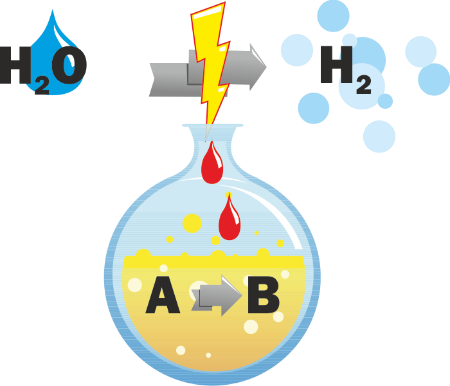





Resource-saving chemistry includes the avoidance of both fossil carbon and rare and valuable metals. For example, precious metals such as platinum, iridium and ruthenium are used in traditional catalysis. It is therefore a very important goal to replace the rare and critical elements with readily available ones. In addition, conventional catalysis can be replaced by other activation modes.
Renewable raw materials and the resulting residual streams, which have so far only been used to a limited extent for the chemical synthesis of precursors for polymer applications or the construction of complex compounds, offer great potential for a sustainable economy. So far, these material flows have mainly been used thermally to generate steam and electricity.
The material use of these biogenic residual material flows for the production of fine chemicals and their use in polymer chemistry as well as in the synthesis of active ingredients still permits thermal use. Without going into the so-called fuel plate problem – after all, material conversion should not compete with food production. Instead of burning the biomass, it is highly desirable to use the material upstream. Only a small part of the primary biomass produced could easily cover the carbon requirements of the chemical industry.